
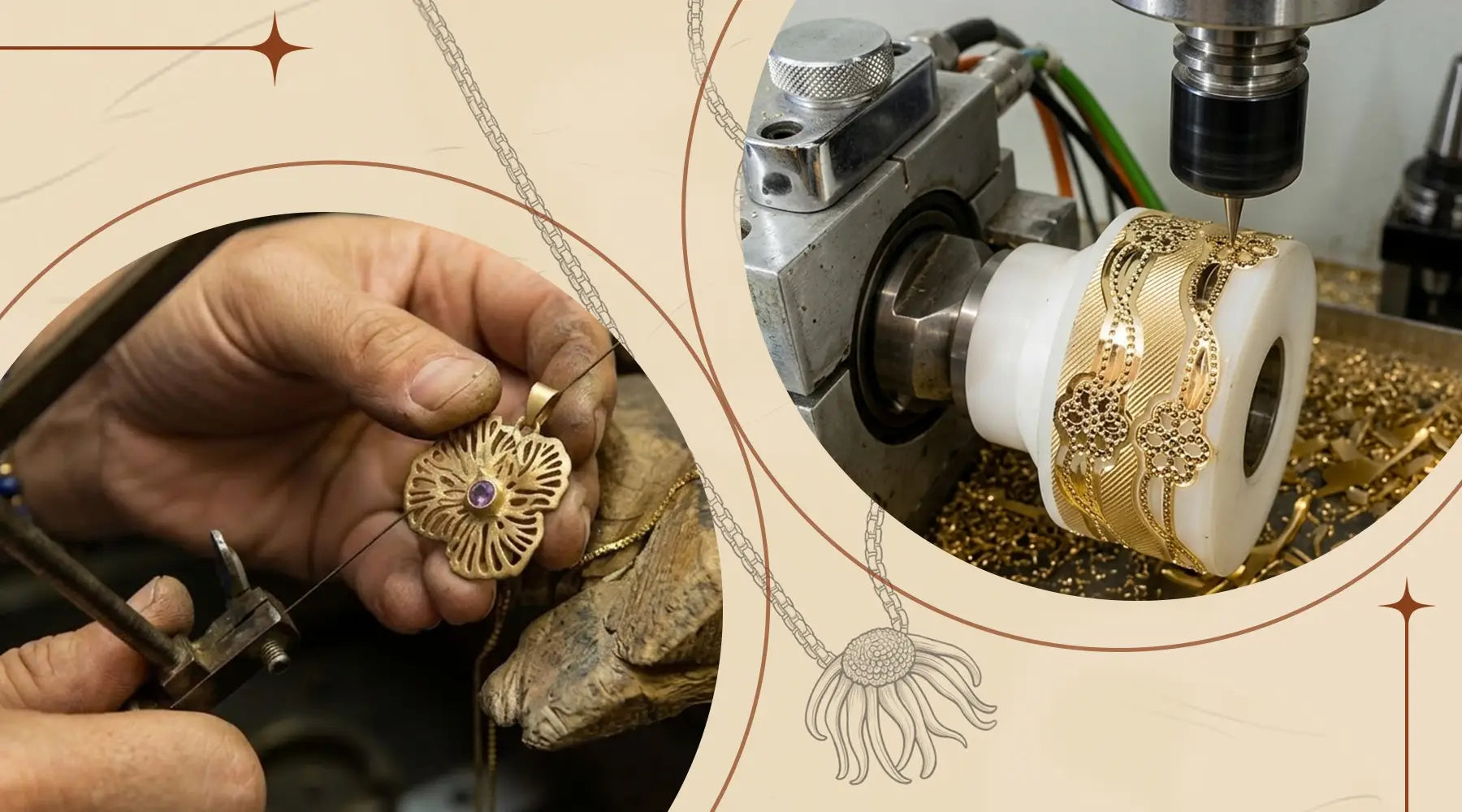
This is a classic debate in the world of precious jewellery. On one hand, you have the perfect imperfection of handmade jewellery and on the other hand, the flawless precision of machine-made jewellery.
Often the term handmade is referred to as things made using hands, but it's more than that. It represents the work of skilled craftsmen who use traditional tools to put a personal, human touch into everything they create.
Instead of relying on heavy factory machines, these artisans focus on traditional techniques that make each piece unique.

How does the production process differ between handmade and machine-made Silver jewellery?
The fundamental difference begins at the workbench, where handmade jewellery is a labor-only-oriented journey of manipulating raw metal wire or sheet by using heat, hammers, and hand tools to build a piece from the ground.
The handmade jewellery is generally made over days or weeks. In contrast, machine-made jewellery relies on CAD (Computer-Aided Design), 3D printing, and die casting, allowing for thousands of identical components to be produced in a fraction of the time with human involvement only during the final polishing stages.
Increasingly, many modern jewellers utilize a mixed or hybrid approach, using CAD to design a perfect structure that is then cast by a machine, then finishing the piece by hand-setting the stones and hand-polishing the metal to give the final product a human touch that pure machine technology cannot achieve.
What are the differences in durability between handmade and machine-made silver jewellery?
When it comes to durability, handmade silver jewellery often has a hidden advantage because the act of hammering, pulling, and rolling the metal by hand hardens it, making the silver denser and much more resistant to bending or scratching. Machine-made pieces are typically produced through casting and pouring molten silver into a mold, which rarely traps tiny, invisible air bubbles known as "porosity." Porosity in general weakens the metal’s internal structure, which is invisible from outside.
Because an artisan hand-builds every part and strengthens every joint during the making, handmade silver jewellery is often built to survive a lifetime of daily wear better than mass-produced jewellery.

In what ways does the design individuality of handmade silver jewellery differ from machine-made pieces
The most noticeable difference for a buyer is that handmade silver celebrates "perfect imperfection," ensuring that no two pieces are ever the same or identical. This is due to the minor variations in the artisan's tool strikes or the way they set a stone.
Machine-made jewellery, however, is built for total uniformity and perfect symmetry, resulting in hundreds or thousands of pieces that look exactly like each other with the exact same shape, number of stones, and prongs. The specialty of a handmade piece is that the craftsman can slightly change or adjust a curve or a design to match the customer's request while creating the jewellery, creating a treasure that feels personal.
However, it is important to note that not all jewellery can be made entirely by hand, certain complex geometric patterns, thin lace-like textures, or perfectly identical parts require the precision of a 3D printer or laser cutter to achieve a level of detail that cannot be achieved using human hands.

What factors contribute to the price differences between handmade and machine-made silver jewellery
Pricing of silver jewellery generally reflects a choice between paying for an artist’s craftsmanship and time or a factory’s production efficiency. Naturally, the handmade items cost more, as they represent hours of skilled labour.
In the case of machine-made jewellery, you buy silver jewellery where you are benefited from ‘economies of scale,' that is, a proportionate saving in costs gained by an increased level of production. It is where the cost of designing one piece is spread across thousands or lakhs of units, making the jewellery more affordable for the buyer.
Machine manufacturing is designed for precision. It has minimal wastage, as it is made with accuracy, which saves a lot on raw materials, making the jewellery low cost for people who want to invest, and is focused on silver’s base value. In contrast, the handcrafted silver jewellery involves comparatively more bench waste, where dust or scraps of silver are lost during sawing, filing, and polishing, which is then combined with the artisan's fee, resulting in the rise of the jewelry's price. However, while the machine-made jewellery is a great option for budget-conscious consumers, handcrafted jewellery is an asset for consumers who value the exclusivity of one-of-a-kind creations.
How does ethical sourcing vary between handmade and machine-made silver jewellery?
Nowadays a precious metal’s environmental impact is as important as its design, with handmade and machine-made processes offering two very different paths to a sustainable future. In 2026, the "how" is just as important as the "what." For handmade jewelry, smaller studios typically have known suppliers and shorter supply chains. An independent jeweller or a small-scale jeweller is more likely to know the exact source from where their raw materials are coming from. Because they produce less, their environmental footprint is significantly smaller. Low environmental footprint means minimising human impact on the environment through reduced resource use, waste, and emissions for a sustainable future.
On the other hand, mass production is also taking up green initiatives like recycling and ethical mining to lower their environmental footprint, but the amount of raw materials required for producing machine-made jewellery carries a heavier environmental weight compared to small-scale production.
However, large-scale machine production requires a massive, continuous flow of raw materials, which can make it harder for large-scale companies to verify each and every step of their supply chain, from the mine to the showroom space. By choosing handmade, we are supporting a process that avoids the waste associated with mass manufacturing and ensuring that the jewellery we buy wasn't produced in a factory with illegal labor practices or high carbon emissions.
How does the method of production influence the craftsmanship seen in handmade and machine-made silver jewellery?
In the handmade jewellery, craftsmanship is not only about how it looks; it is also about the strength built into the piece through hours of manual work, such as hammering, forging, and twisting the metal to make it stronger and sturdier. This process is completely human-led from the start to the end, ensuring every step is done to perfection. In the case of machine-made jewellery, it is all about perfection and precision. The machines can create complex patterns that are not possible with human hands, but they often lack the strength and soul of a piece that was built on a jeweller’s bench.
Ultimately, choosing between these two depends on what you value the most. On one side, modern machine-made jewellery offers flawless precision and intricate details. On the other side, handmade jewellery offers human connection, which makes the jewellery feel like a meaningful part for the wearer, often reflecting the artisan's craftsmanship and technique that can resonate deeply with the individual.


Featured in This Blog
Amethyst Studded Pendant Necklace
Delicate Flower Pendant Necklace
Adjustable Cascading Flower Ring
Double Line Ring
Tiered Triangle Dangler Earring
Adjustable Amethyst Studded Statement Ring
Amethyst & Peridot Filigree Earring
Amethyst Silver Dangle Earring
Amethyst Stone Bird Pendant Necklace
Black Enamel Cuff Bracelet
Bloom Spiral 18K Gold Plated Ring
Boho Gold Neon Earrings
Share:
Gold vs Silver: Which Is Better For Indian Weather?
How to Spot Fake Gold Plated Jewellery Before You Buy